 merrick-2002andGenOffice
d24c964a3e
- **New app: GenOffice HTML.** Open, edit and generate .html pages: a source pane with a sandboxed live preview, click-to-select elements with a floating toolbar and style panel, device-size preview, image tools and a present mode. AI generates whole pages from a brief with style directions and offers page-wide Restyle, Theme and Summarize. Export to Word runs locally through the built-in html2docx converter (native, editable OOXML; no print-to-PDF detour).
- **AI:** separate BYOK providers for web search, image generation and image/video analysis; new Codex App Server provider; Ask AI quotes the selected text and keeps it highlighted while it runs; custom AI panel text size; blocked requests retry through the Chromium network stack.
- **App:** global AutoSave setting shared by every editor; AI panel text size and chat spellcheck toggles (genoffice#249); Czech (cs) UI locale (genoffice#259); Save As defaults to the document's folder; PDF export no longer aborts on CJK file paths on Windows.
- **Docs:** Export as HTML; comments and replies edit in place from the comments pane; the caret can leave a trailing table (genoffice#266); spellcheck re-marks text as soon as it is re-enabled; AI edits are character-precise on partial selections; zoom keeps the scroll position; pasting a cell from Sheets takes the destination font.
- **Sheets:** Find no longer freezes on wide or streamed grids; Replace searches as you type; cached values of external-workbook formulas are kept instead of #ERROR! (genoffice#235); "number stored as text" is a warning, not an error (genoffice#236); paste repeats into the target range like Excel; filter criteria survive save/reopen; saves retry when Windows locks the file; many Excel-fidelity fixes for column widths, row heights, charts, slicers, number formats and CJK fonts.
- **Slides:** PDF export works for large presentations (genoffice#264); EMF/WMF picture fonts and East Asian theme fonts resolve correctly; decks with missing layouts or embedded styles still open; outline-only pie slices render.
- **PDF:** highlight and underline geometry aligns with the text; Shift+arrows extend the selection instead of paging.
- **Markdown:** Find and replace (Ctrl+F / Ctrl+H) (genoffice#253); mermaid code blocks render as diagrams (genoffice#263); better print quality.
- Thanks to community contributors @GoodScholar, @aniruddhaadak80 and @Sun8854, and to @hanyscz, @qgzln, @zyp997, @bisslot, @krakotay and @Ben03151 for the reports.

Co-authored-by: GenOffice <merrick-2002@users.noreply.github.com>
GenOffice
The world's first full-featured open-source AI Office suite.



Website · Download · Privacy · Demo
GenOffice is a free, open-source alternative to Microsoft Office for macOS,
Windows, and Linux, built around AI editing as a first-class workflow rather
than a bolted-on chat box. It opens and saves the real Microsoft Office
formats — Word (.docx), Excel (.xlsx), PowerPoint (.pptx) — and edits
PDF, Markdown, and HTML too: a word processor, spreadsheet, presentation
editor, PDF editor, Markdown editor, and a design-first AI HTML page builder
as seven Electron apps sharing one engine layer.
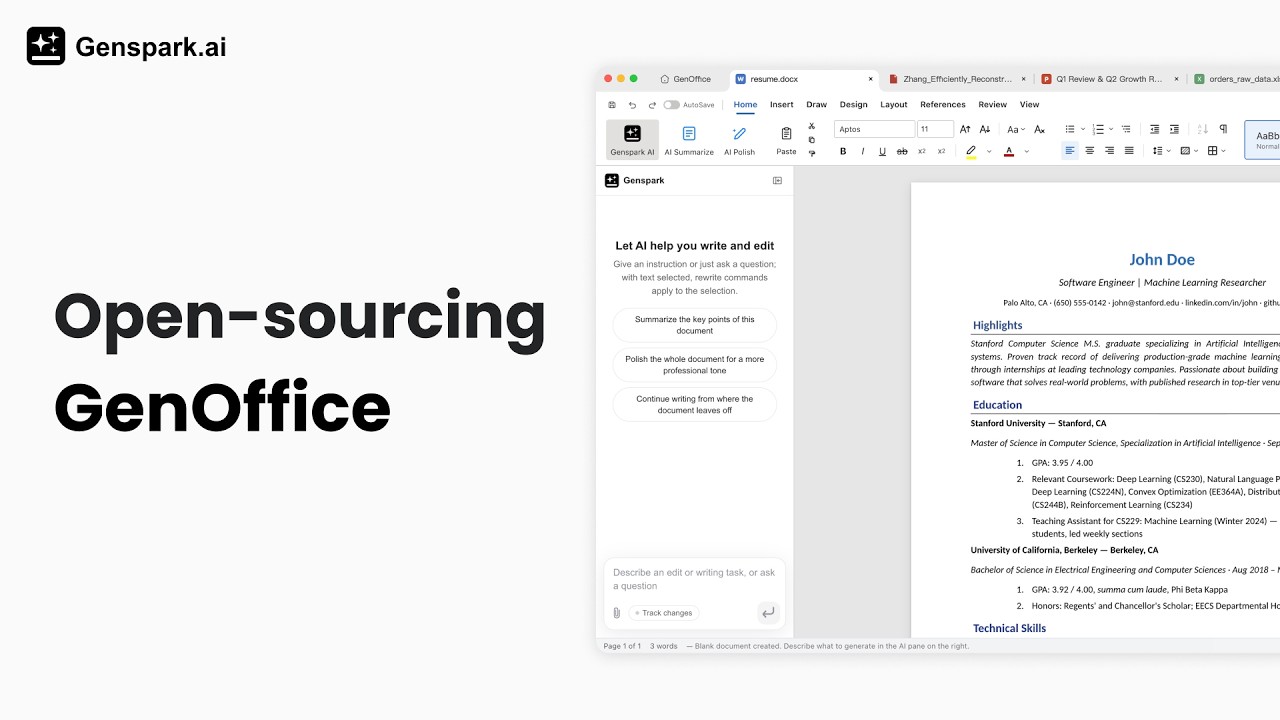
Watch the demo video on YouTube
Features
- Real PDF editing — retype text and edit images in the page itself, original fonts preserved.
- Local PDF → Word / PowerPoint / Excel conversion — turn a PDF into an editable
.docx,.pptx, or.xlsxentirely on your machine: no cloud, no upload. - Scanned PDFs too — on macOS and Windows scanned pages are read with the system OCR, so they convert to editable text.
- Microsoft Word–compatible, byte-preserving
.docxediting — only what you touched changes; Word never notices. - Word-faithful pagination — page breaks land where Word puts them.
- Excel-compatible spreadsheets — in-house engine with a Rust
.xlsxsidecar, own charts, pivot tables, slicers. - PowerPoint-compatible presentations — in-house
.pptxengine with masters, layouts, smart guides, non-destructive crop. - Markdown to Word, fully local — the same OOXML engine, no Pandoc, no cloud.
- HTML to Word, fully local — Export as Word renders the page in the built-in Chromium, reduces it to a document intent tree (headings, paragraphs, lists, tables, cards, KPI rows, form fields, page backgrounds) and writes native, editable OOXML; only visuals with no Word counterpart (charts, icons, decorated boxes) become pictures. No print-to-PDF detour, no cloud.
- AI-designed HTML pages — generate landing pages, reports, and posters as single self-contained HTML files, design-first; a Write content mode for plain articles.
- AI that edits documents — block-level edits with snapshots and diffs, document-aware agents.
- Bring your own key (BYOK) — run the AI on your own API key: Claude, OpenAI, Gemini, DeepSeek, Kimi, GLM, Qwen, Doubao, MiniMax, Grok, Mistral, OpenRouter, OpenCode Zen/Go, or any OpenAI-compatible endpoint — or sign in with Genspark and skip keys entirely.
- BYOK for search and media too — web search on your own Serper or Tavily key; image generation, image analysis, and video analysis each on the provider you choose (OpenAI, Gemini, Doubao/Seedream, GLM, Grok, Qwen, MiniMax, or any OpenAI-compatible images endpoint), configured per capability in AI Media & Search.
- Agent tools built in — web/image search, image generation, media analysis.
- Light / dark / system themes.
- macOS, Windows, Linux.
- Free & open-source (Apache-2.0).
Download
| Platform | Requirements | Download |
|---|---|---|
| macOS — Apple Silicon (arm64) | macOS 11+ | Latest .dmg (arm64) |
| macOS — Intel (x64) | macOS 11+ | Latest .dmg (x64) |
| Windows (x64, most PCs) | Windows 10+, Intel/AMD | Latest -x64.exe installer |
| Windows on Arm (ARM64) | Windows 11 on Arm (Snapdragon X and similar) | Latest -arm64.exe installer |
| Linux — Debian / Ubuntu | x86_64, glibc 2.34+ (Ubuntu 22.04 or newer) | Latest .deb |
| Linux — Fedora / RHEL / openSUSE | x86_64, glibc 2.34+ (Fedora 35+, RHEL 9+, Leap 15.6+) | Latest .rpm |
| Linux — other distributions | x86_64, glibc 2.34+, FUSE 2 | Latest .AppImage |
All builds come from main; the macOS and Windows installers are signed.
Older versions are on the Releases page.
Installing on Linux
The deb installs with apt — it pulls in the dependencies and adds GenOffice to the applications menu:
sudo apt install ./genoffice_<version>_amd64.deb
On Fedora / RHEL-family / openSUSE, install the rpm instead:
sudo dnf install ./genoffice-<version>.x86_64.rpm     # Fedora / RHEL family
sudo zypper install ./genoffice-<version>.x86_64.rpm  # openSUSE
The AppImage instead runs in place: install the FUSE 2 runtime
(sudo apt install libfuse2; on Ubuntu 24.04 the package is libfuse2t64),
make the file executable, then run it:
chmod +x GenOffice-<version>.AppImage
./GenOffice-<version>.AppImage
Apps
| App | Product | What it is |
|---|---|---|
apps/docs |
GenOffice Docs | .docx word processor. Byte-preserving round trip: only dirty paragraphs are regenerated (paragraph patch), everything else in the original file is kept byte-for-byte, so opening and saving never breaks layout in Word. Paginated view whose line metrics reproduce the original document's layout, tracked changes, comments, styles, equations, ink. |
apps/sheets |
GenOffice Sheets | .xlsx spreadsheet. UI built on the open-source Univer core (Apache-2.0) with a large layer of in-house extensions; .xlsx import/export runs through an in-house Rust sidecar (calamine + IronCalc), charts are rendered in-house (Konva), plus pivot tables, slicers, conditional formatting, and formula tracing. |
apps/slides |
GenOffice Slides | .pptx presentations. In-house .pptx parse/render/edit engine with masters, charts, cropping, ink, and text shaping (HarfBuzz metrics). |
apps/pdf |
GenOffice PDF | .pdf viewer/editor on pdf.js (Apache-2.0) + pdf-lib (MIT): annotations, forms, outlines, stamps, signatures, page operations, and printing support. True text editing — paragraph selection with in-block reflow, alignment restoration, original-font preservation — and content-stream image insert/edit, all rewriting page content streams through PDFium wasm (BSD-3-Clause) with subset-embedded fonts — no cover-up annotations. Converts PDFs into editable Word, PowerPoint, and Excel files fully locally (packages/pdf2docx), with OCR support for scanned pages (system OCR on macOS and Windows). |
apps/html |
GenOffice HTML | Single-file .html page builder, design-first. A blank page starts from two intents: Design a page (the AI proposes a design brief — hook, palette, typography, section layouts — with alternative style directions to pick from, then writes the page against --brief-* design tokens) or Write content (an article, announcement, or guide written straight into a clean page). Live sandboxed preview with an inspector: click to select an element, double-click to edit text, a floating toolbar and style panel for typography, box, color, and image edits, and element-scoped Ask AI; CodeMirror source view kept in sync; desktop / tablet / phone widths; Present in the tab, fullscreen, or a new tab; export to PDF, and to Word as a native editable .docx built on-device by packages/html2docx. |
apps/markdown |
GenOffice Markdown | .md / .markdown editor: Tiptap block editor over plain Markdown files — headings, lists, tables, images, code blocks — saved back as plain Markdown, hosted in shell tabs. |
apps/shell |
GenOffice | The suite shell: home screen, tabbed hosting of the six editors, light/dark/system theme, auto-update. |
Every app embeds the same AI panel: block-granular AI editing with version snapshots and diffs in docs, a tool-calling agent over workbook/slide/PDF state in the others.
The whole suite ships light / dark / system UI themes built on shared design
tokens (packages/ui), with a CI guard that keeps chrome colors on the token
system. Dark mode follows the Office apps it mirrors: Docs and Sheets render a
dark page with contrast-remapped colors (Docs' View ▸ Dark Mode switches back to
a white page, like Word's Switch Modes), while slides, PDF pages and every
export keep the document's own colors — the theme only ever changes what is on
screen, never what is in the file.
AI backends — Genspark sign-in or bring your own key. By default the
apps sign in to a Genspark account through a device-code flow — no model API
key to enter — and model calls route through the Genspark proxy (Claude,
GPT, and Gemini families). Or bring your own key (BYOK) in the AI settings:
Claude, OpenAI, Gemini, DeepSeek, Kimi, GLM, Qwen, Doubao, MiniMax, Grok,
Mistral, OpenRouter, and OpenCode Zen/Go are built in, plus a custom provider
slot for any OpenAI-compatible endpoint (base URL + key), local servers
included. Image generation and image/video analysis have their own provider
catalog (AI Media & Search settings): OpenAI, Gemini, Doubao/Seedream, GLM
CogView, Grok Imagine, Qwen-Image, MiniMax or any OpenAI-compatible images
endpoint, each with its own key and assignable per capability; web search can
likewise run on your own Serper or Tavily key. A
Genspark account also unlocks the Genspark ("gsk") tool endpoints the agents
build on — web and image search, image generation and editing,
image/audio/video analysis, and audio transcription — all reachable through
packages/ai-search for anyone extending the agent layer.
Engine packages
All pure TypeScript, no Electron dependency, unit-tested (except the UI kit):
packages/docx-engine— docx parsing → block tree (withdocxIndexanchors and passthrough), OOXML fragment generation, byte-level paragraph patching.packages/pptx-engine/packages/pptx-render— pptx model and rendering.packages/pdf2docx— local PDF → DOCX conversion: PDFium character-level extraction, pure-geometry layout analysis, rebuild throughdocx-engine; the same analysis drives the PDF app's PowerPoint and Excel exports.packages/html2docx— local HTML → DOCX conversion: the page is rendered in the app's own Chromium, reduced in-browser to a document intent tree, and written as native OOXML with thedocxlibrary; only visuals with no Word counterpart are screenshotted. Drives the HTML app's Export as Word.packages/file-parse— text extraction for AI attachments (office formats, text formats).packages/agent-core— the AI agent loop and skill composition shared by every app.packages/ai-provider— provider abstraction and streaming for the model backends.packages/ai-search— Genspark auth + web/image search tools.packages/i18n,packages/ui,packages/project-store,packages/electron-utils— shared i18n core, React UI kit, recent-files store, and Electron main-process helpers.
Development
npm install
npm run fixtures     # generate test .docx fixtures
npm test             # engine + app unit tests (docs/sheets/slides need no display)
npm run typecheck    # tsc --noEmit across every workspace
npm run dev          # all six editors + shell against Vite dev servers
npm run dev:docs     # a single app (same pattern works per workspace)
npm run dist:mac     # package macOS dmg (regenerates third-party notices)
npm run dist:win     # package Windows nsis installer
npm run dist:linux   # package Linux AppImage + deb + rpm
The sheets app additionally needs a Rust toolchain for its xlsx sidecar
(cargo on PATH); npm run build -w @genoffice/sheets compiles it
automatically.
Architecture notes (docx round trip)
open docx ─► archive original by hash (never touched)
          ─► docx-engine parses word/document.xml top-level elements (w:p / w:tbl / …)
          ─► Block tree, each block anchored by docxIndex + original XML slice
          ─► Tiptap streaming editor (manual + AI editing, dirty tracking)
save      ─► dirty blocks → OOXML fragments (referencing existing styles only)
          ─► splice into original document.xml (untouched blocks keep original bytes)
          ─► repack zip; all other entries copied byte-for-byte
The same philosophy holds in sheets and slides: the original file is the source of truth, edits are applied as narrow patches, and everything the editor didn't touch survives the round trip untouched.
FAQ
Is GenOffice free? Yes. GenOffice is free and open-source under the Apache-2.0 license — no trial, no paid tier for the apps themselves.
Can GenOffice open Microsoft Word, Excel, and PowerPoint files?
Yes. GenOffice opens and saves native .docx, .xlsx, and .pptx files.
Saving is byte-preserving: parts of the file you didn't touch are written
back byte-for-byte, so documents keep working in Microsoft Office.
Does GenOffice work offline? Document editing is fully local — files never leave your machine to be opened, edited, or saved. The AI features (agents, search, image tools) need a network connection, with either a Genspark sign-in or your own model API key (BYOK).
Can GenOffice edit PDF files? Yes — real PDF text and image editing that rewrites the page content stream with the original fonts preserved, not cover-up annotations.
Can GenOffice convert PDF to Word, Excel, or PowerPoint?
Yes — GenOffice converts PDFs into editable .docx, .xlsx, and .pptx
files entirely on-device: PDFium character-level extraction plus
geometry-based layout analysis, no cloud service, no upload. Scanned pages are
covered too — on macOS and Windows the system OCR reads them, so they convert
to editable text rather than a page image.
Can I use my own AI model or API key? Yes. Besides the keyless Genspark sign-in, GenOffice supports bring your own key (BYOK) for Claude, OpenAI, Gemini, DeepSeek, Kimi, GLM, Qwen, Doubao, MiniMax, Grok, Mistral, OpenRouter, and OpenCode Zen/Go, plus any OpenAI-compatible endpoint — including local model servers.
Can I bring my own keys for search, image generation, and media analysis? Yes. Settings → AI Media & Search takes separate keys per capability: web search on Serper or Tavily, and image generation, image analysis, and video analysis each on OpenAI, Gemini, Doubao/Seedream, GLM, Grok, Qwen, MiniMax, or any OpenAI-compatible images endpoint. Anything left on Genspark keeps using your Genspark sign-in.
Can GenOffice design web pages?
Yes. GenOffice HTML is a design-first page builder: describe a landing page,
report, or poster, pick a style direction from the proposed design brief, and
the AI lays out a single self-contained .html file you then refine visually
— select an element to restyle it or ask AI about it. Pages present
fullscreen and export to PDF and Word.
Can GenOffice convert HTML to Word?
Yes — Export as Word in the HTML app produces a native, editable .docx
entirely on-device. The page is rendered in the built-in Chromium and reduced
to real Word structures: headings, paragraphs, lists, tables, cards, KPI rows,
form fields, and page backgrounds; only visuals with no Word counterpart
(charts, icons, decorated boxes) are embedded as pictures. Nothing is printed
to PDF first and nothing is uploaded.
Does GenOffice collect any data? Official packaged builds send limited usage analytics by default, and you can disable reporting at any time under Settings → General. Analytics never sends document content, file names, file paths, account identity, or email addresses. See GenOffice Privacy for the complete event and data disclosures.
Security
See SECURITY.md for the process security posture (renderer sandboxing, IPC validation, external-link gating) and the threat models for AI-generated content.
Acknowledgements
GenOffice would not be possible without these open-source projects:
- Electron — the desktop runtime for every app.
- Univer (Apache-2.0) — the spreadsheet UI core that Sheets extends.
- PDFium (BSD-3-Clause, bundled via @embedpdf/pdfium) — the content-stream engine behind true PDF text and image editing.
- pdf.js (Apache-2.0) and pdf-lib (MIT) — PDF rendering and document assembly.
- Tiptap / ProseMirror — the block editors in Docs and Markdown.
- CodeMirror (MIT) — the source editor in HTML.
- Konva — canvas rendering for Slides and Sheets charts.
- HarfBuzz (wasm) — text-shaping metrics for complex scripts.
- calamine and IronCalc — the read and calc layers of the Rust xlsx sidecar.
- Liberation, Carlito, Caladea, and Noto CJK fonts (OFL/Apache-2.0) — bundled document fonts.
Third-party notices
npm run notices regenerates the bundled third-party license summary
(tools/gen-third-party-notices.mjs); all runtime dependencies are
MIT/Apache-2.0/BSD-3-Clause/OFL, and the bundled fonts (Liberation, Carlito,
Caladea, Noto CJK subsets) are OFL/Apache.
License
GenOffice is licensed under the Apache License 2.0, with one
exception: the ee/ directory is reserved for future enterprise modules and
is covered by the GenOffice Enterprise License.
The GenOffice and Genspark names and logos are trademarks of Mainfunc, Inc. The Apache-2.0 license does not grant permission to use them (see section 6); forks should use their own branding.